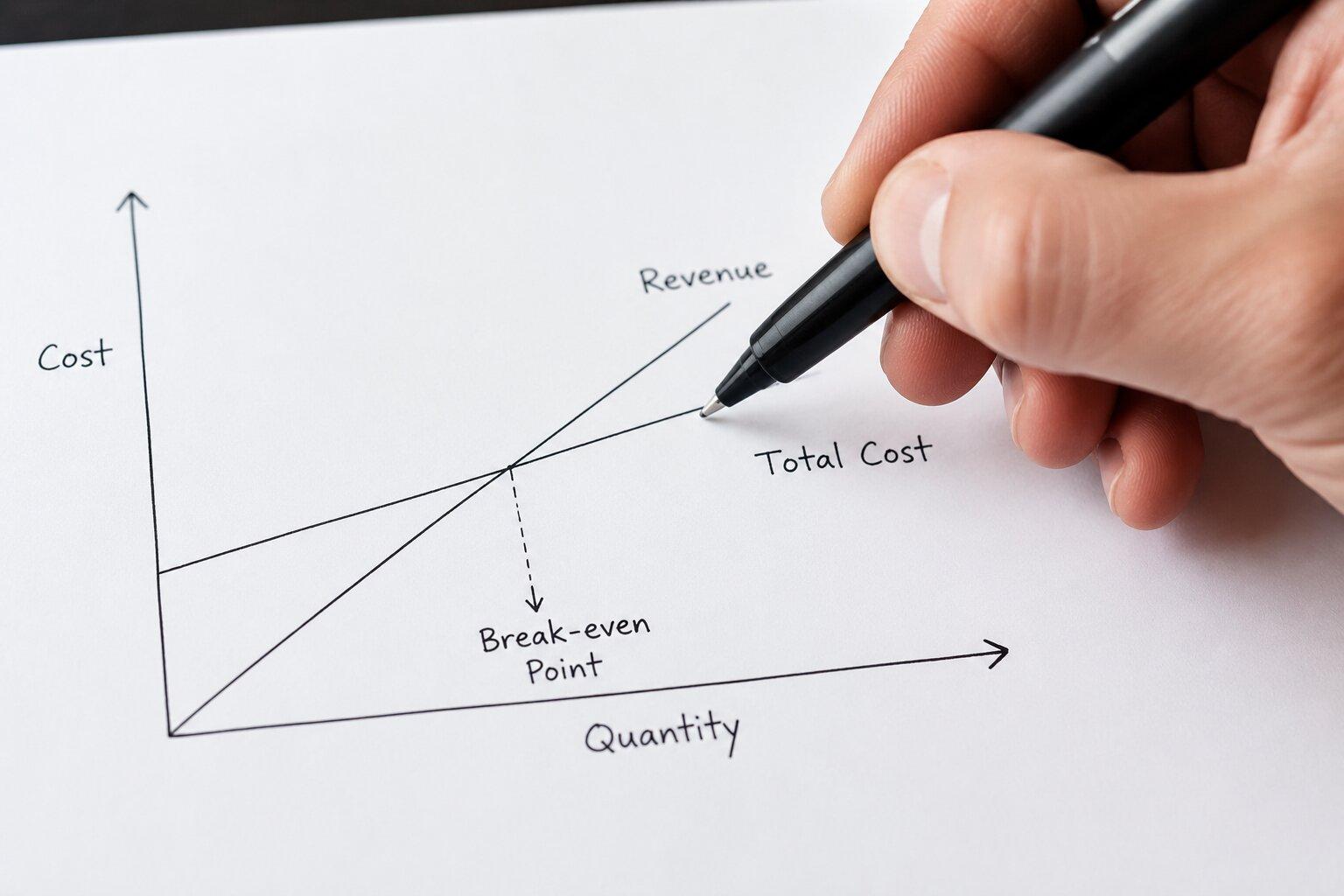
Break-Even Point: Calculate the Exact Revenue Your Business Needs to Stop Losing Money
If your fixed costs are EUR18,000 a month and your contribution margin is 45%, you need EUR40,000 in sales before you make a single euro of profit. Most owners have no idea what their number is — and price, hire, and spend as if the floor doesn't exist.
What the break-even point really tells you
The formula is simple: fixed costs divided by contribution margin. Contribution margin is the part of each sale that remains after variable costs. If you sell a product for 50 euros and variable costs are 20 euros, the contribution margin is 30 euros. If monthly fixed costs are 9,000 euros, you need 300 sales to break even.
Break-even is not the same as profit target. It is the minimum level of sales needed so the business does not lose money. After break-even, each additional sale contributes to profit according to its margin. Before break-even, every sale helps absorb fixed costs but the business is still recovering the cost of opening the doors, paying the team and keeping the operation running.
This is why the break-even point is useful for restaurants, dental practices, bars, retail shops and service businesses. It connects pricing, fixed costs, variable costs and volume in one number. If that number is unrealistic, the issue is not motivation; it is business model, margin or cost structure.
Formula in units and in revenue
If you sell one main product or service, calculate break-even in units: fixed costs / contribution margin per unit. If your business sells many products, use contribution margin percentage: fixed costs / contribution margin %. For example, if fixed costs are EUR18,000 and the average contribution margin is 45%, the business needs EUR40,000 of monthly revenue to break even.
Contribution margin % = (sales - variable costs) / sales x 100. If monthly sales are EUR80,000 and variable costs are EUR44,000, contribution margin is EUR36,000, or 45%. With EUR18,000 fixed costs, break-even is EUR40,000. With EUR30,000 fixed costs, break-even jumps to EUR66,667 even though prices did not change.
Numerical example for a restaurant
A restaurant has EUR22,000 of monthly fixed costs: rent, management salaries, software, insurance, accounting and equipment leases. Its average food and variable operating costs are 38% of sales, so contribution margin is 62%. The break-even revenue is EUR22,000 / 0.62 = EUR35,484. If the average ticket is EUR28, the restaurant needs about 1,268 covers per month, or 42 covers per day in a 30-day month.
This number is more useful than a vague sales target. If the dining room can realistically do 35 covers per day in low season, the owner knows the business needs action before the season starts: reduce fixed costs, improve average ticket, protect food cost, change opening days or add profitable revenue streams.
Margin of safety: how much you can afford to lose
Knowing your break-even isn't enough if you don't know how far your current sales are from that line. Margin of safety answers that: how much current sales could drop before the business tips back into a loss.
Margin of safety % = (current sales - break-even sales) / current sales x 100. If you sell EUR50,000 a month and break-even is EUR37,000, margin of safety is (50,000 - 37,000) / 50,000 = 26%. Sales could drop 26% before the business goes into a loss — a useful buffer to gauge exposure to a slow season, a lost client, or a weak month. Below 15-20% signals a fragile business, where even a small sales swing threatens profitability.
Common mistakes
Calculating break-even only once is the most common error. Prices, supplier costs, payroll and delivery commissions change constantly. A restaurant, dental practice or service business should update the break-even point whenever the cost structure changes.
Using gross revenue instead of net revenue distorts the calculation. Taxes collected for the state are not margin. Delivery commissions, refunds and discounts reduce what the business actually keeps and should be stripped out before applying the formula. Owner salary is another gap: if the business only breaks even because the owner pays themselves nothing, the break-even point is not real.
Before making this decision
Check fixed costs, variable costs, average margin, realistic sales volume, average ticket and seasonality. Then ask what happens if sales are 10% lower than expected or supplier costs increase by five points. A break-even calculation that works only in the best month is not a safe base for hiring, debt or expansion.
The most useful version is a small scenario table: conservative month, normal month and strong month. For each scenario, write revenue, variable cost percentage, fixed costs and expected result. This turns break-even from a static formula into a decision tool for opening hours, staffing, pricing and investment timing.
Once you know the break-even point, pricing becomes clearer. You can test whether a discount, a new service, a delivery channel or a new hire increases profit or only increases revenue without enough margin.
To make the number more reliable, connect it with your fixed cost base and your annual budget. EUSTAK helps by keeping invoices and recurring costs visible, so break-even can be updated when the business changes instead of once a year.
Frequently asked questions
Should I calculate break-even in units or in revenue?+
Does the owner's salary count as a fixed cost in the break-even calculation?+
How do delivery commissions affect the break-even point?+
What is margin of safety and how do I calculate it?+
The starting point is knowing your margin per dish: the food cost and margin calculator works it out from your real prices.
See how many sales you still need to break even this month
EUSTAK reads your invoices, classifies fixed and variable costs, and updates your break-even every month without manual data entry.
Calculate my break-even