The hidden hours of running a lab: invoices, materials and cost per unit
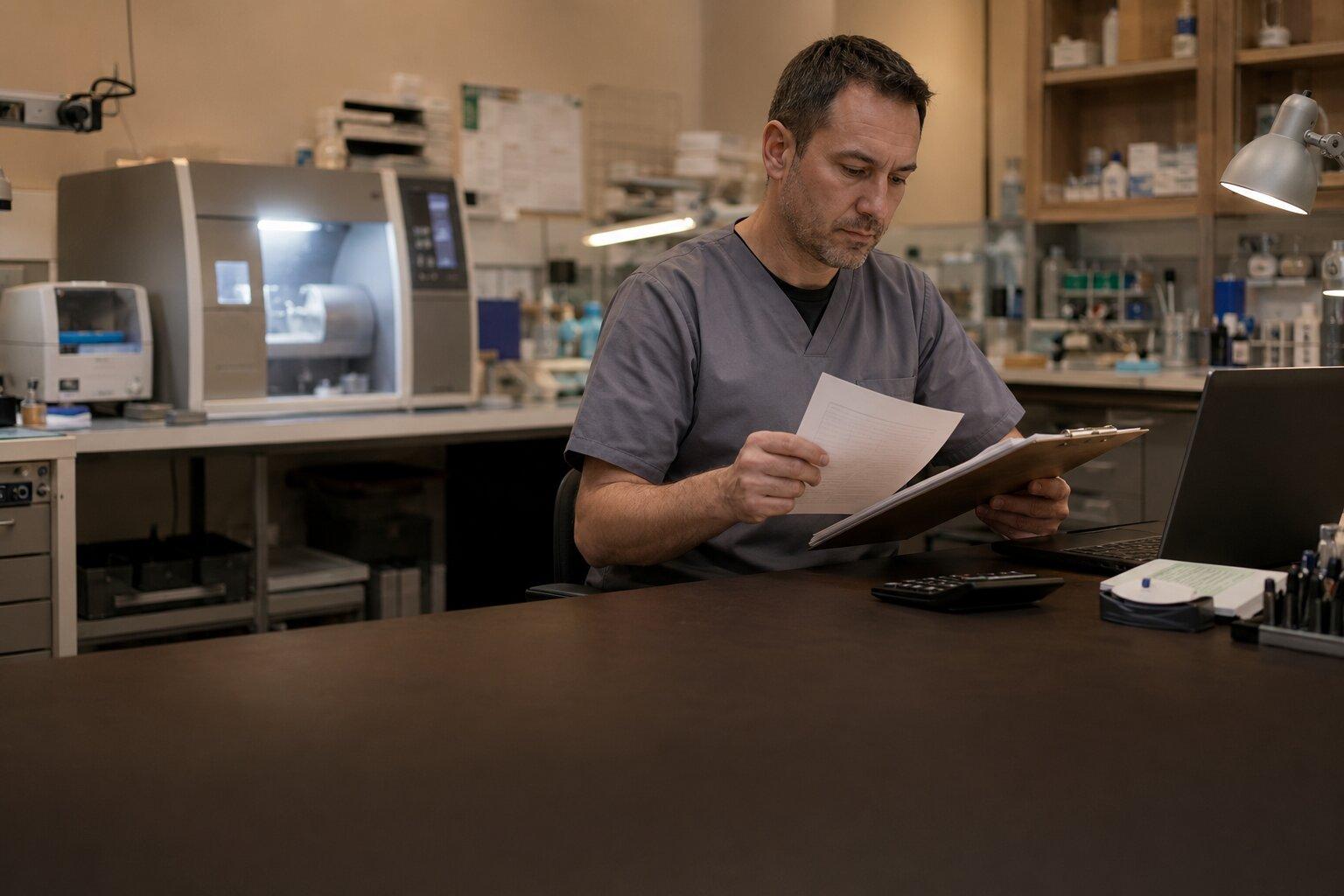
In a dental lab, admin time is invisible until you count it, and there is almost never anyone else to hand it to. According to Key-Stone OmniVision research (2024), 74% of Italian labs have three people or fewer (figure cited by Dental Tribune Italy); the same survey, reported by Confartigianato Vicenza, puts the average owner age at 58 and 30% with no succession plan. In a structure like that, whoever handles the invoices is almost always the same person who should be at the workbench — and in a lab, that time adds up across invoices for zirconia disks, alloys, resins and outsourced milling. How much it adds up to, you can estimate below with your own numbers.
Where the hours go
A lab's admin work hides in repetitive tasks that look quick but aren't. Data entry, price checking and filing on a single invoice takes roughly 12-15 minutes — in line with published accounts-payable benchmarks for manual invoice handling (Ardent Partners, State of ePayables).
- Material invoices — zirconia disks, alloys, resins, PMMA: prices that shift with every order.
- Outsourced milling invoices — if part of the work goes out, that's another variable cost line to check invoice by invoice.
- Price checking — verifying whether a supplier raised the cost of a material compared to the previous order.
- Cost-per-unit updates — carrying the new costs into the price list, unit type by unit type. This is the step almost no lab does consistently.
What invoices really cost you
Estimate below the hours invoice management takes from you in a year. The figure almost always surprises people once it is translated into working days.
If your time is worth even $25 an hour, 9 hours a month is $225 in hidden labour — $2700 a year that shows up on no price list but you are paying it regardless.
The crown fee has fallen. Margin only holds if you know the real cost.
According to the NADL 2019 survey (cited by Inside Dental Technology), the average fee for a zirconia crown fell from $218 in 2010 to $143 in 2019, a 34% drop in a decade driven by the spread of digital milling and low-cost outsourced milling centers. Over the same period, retail prices for zirconia disks remain widely variable, from $49 to over $220 for a 98mm disk depending on brand and thickness. With a falling fee and material cost that varies this much supplier to supplier, knowing the real cost per unit is no longer a detail: it's the difference between a margin that holds and one that quietly thins out.
Updating cost per unit by hand on every price change is the work that eats the hours. That is why almost no lab does it consistently, and the price list keeps running on old numbers while the real cost has already moved.
What changes with automation
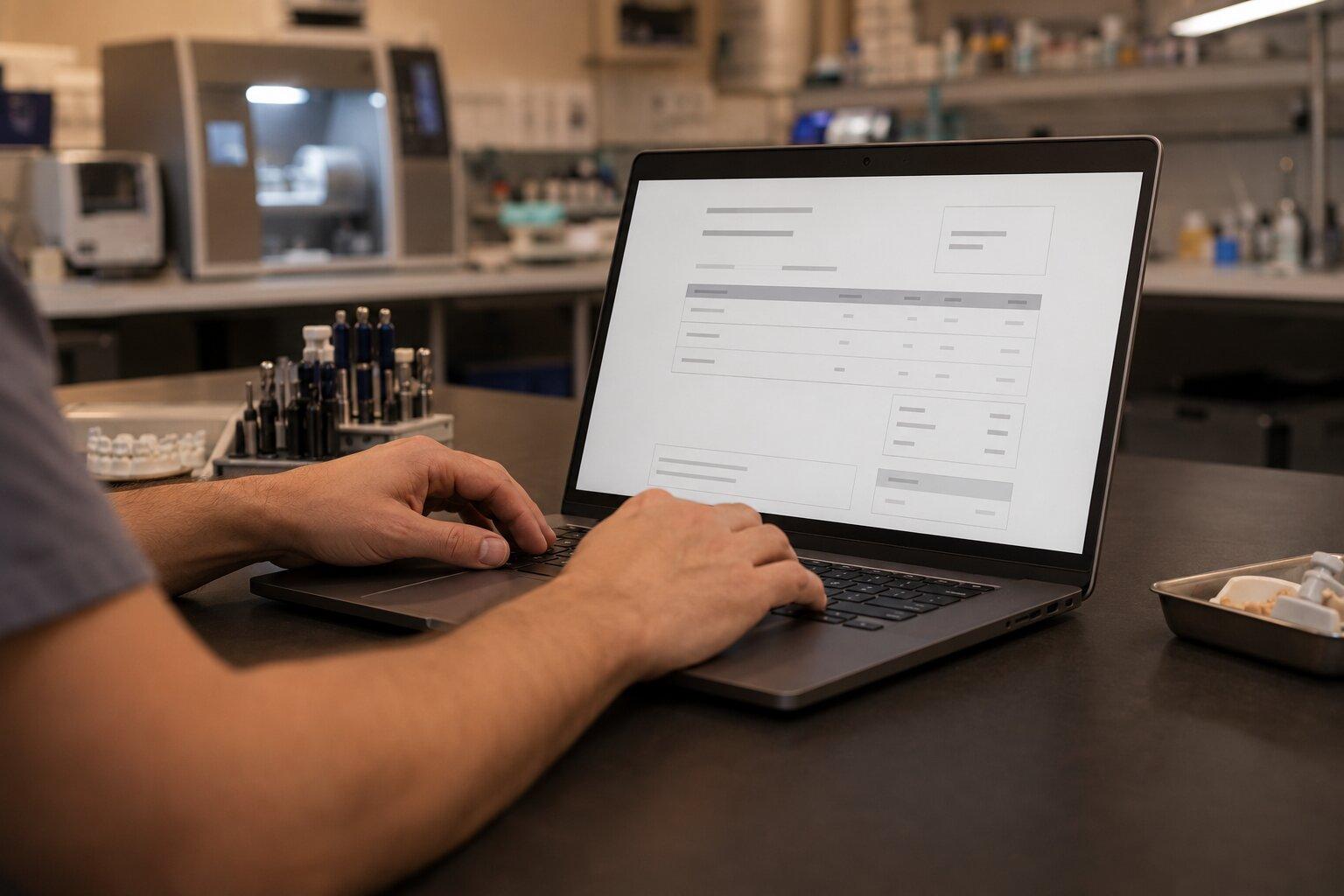
Automation leaves suppliers and invoices in place. It removes the manual work around them. When prices are extracted automatically from invoices and propagated into the calculation, cost per unit updates itself on every delivery.
- Automatic price extraction — the invoice goes in once, the costs land in the system without manual typing.
- Automatic price checking — you know immediately if a supplier raised a price compared to the previous order, instead of finding out buried in dozens of invoice lines at month-end.
- Always-current cost per unit — every material increase is reflected immediately in the margin of every crown, bridge or denture on the price list.
- Time given back — the hours taken by manual entry return to the workbench.
Where to start
You don't need to change everything at once. The first step is to quantify: how many hours you are really spending on admin and how much margin you are losing to a frozen cost per unit. The simplest way is to start with a single price-list item, one crown or one bridge, and see exactly how much material and production time actually go into it.
A spreadsheet works for doing this once. The problem is when you have ten unit types, five suppliers and prices changing every month: recalculating by hand each time is not sustainable.
To run that first check in seconds, try the free dental lab production cost calculator: enter your indirect costs and productive hours and get your hourly rate and real cost per unit.
Frequently asked questions
How many hours a month does running a dental lab take in admin?+
Why does recalculating cost per unit on every invoice take so much time?+
What happens if cost per unit in the price list is never updated?+
Does automation make sense for a small or one-person lab?+
The hours you just calculated above, the calculator gives back to you
It extracts prices from supplier invoices automatically and updates the cost per unit on your price list on every delivery, no manual entry required.
Discover the calculator for dental labs